AC and DC
AC — Alternating Current
- The current changes direction periodically.
- Commonly used for homes, buildings, and power distribution.
- In India, household supply is typically 230 V, 50 Hz AC.
- Example: wall sockets, fans, refrigerators, lights.
DC — Direct Current
- Current flows in one direction.
- Common sources include batteries, power banks, and solar panels.
- Example: a 1.5 V AA battery or a 12 V battery.
| Feature | AC | DC |
|---|---|---|
| Direction | Changes periodically | One direction |
| Common source | Power grid | Battery/solar |
| Typical household use | Yes | Usually after conversion |
| Example | 230 V mains | 12 V battery |
2. Basic electrical terms
- Voltage (V): Electrical potential difference; like the “pressure” pushing current.
- Current (A): Flow of electric charge.
- Resistance (Ω): Opposition to current flow.
- Power (W): Rate at which electrical energy is used.
Important formulas:
Ohm’s Law:
V = I × R
Therefore:
I = V / R
Power:
P = V × I
Example: A 12 V device drawing 2 A uses:
P = 12 × 2 = 24 W
3. Wire colour codes
For modern Indian/IEC-style wiring, the commonly used colours are:
| Conductor | Typical colour |
|---|---|
| Live / Phase (L) | Brown |
| Neutral (N) | Blue |
| Earth / Protective Earth (PE) | Green-yellow |
For DC circuits, colours are commonly:
- Red = positive (+)
- Black = negative (−)
However, never identify a wire by colour alone. Existing installations can use older or non-standard colour schemes. Always verify with appropriate test equipment and follow the applicable wiring standard.
4. Basic circuit
A simple circuit needs a source, conductors, a control/load, and a complete path.
       + ─────── Switch ─────── Lamp ─────── +
       │                                      │
       └──────────── Battery ─────────────────┘
When the switch is closed, current can flow and the lamp turns on.
When the switch is open, the circuit is broken and the lamp turns off.
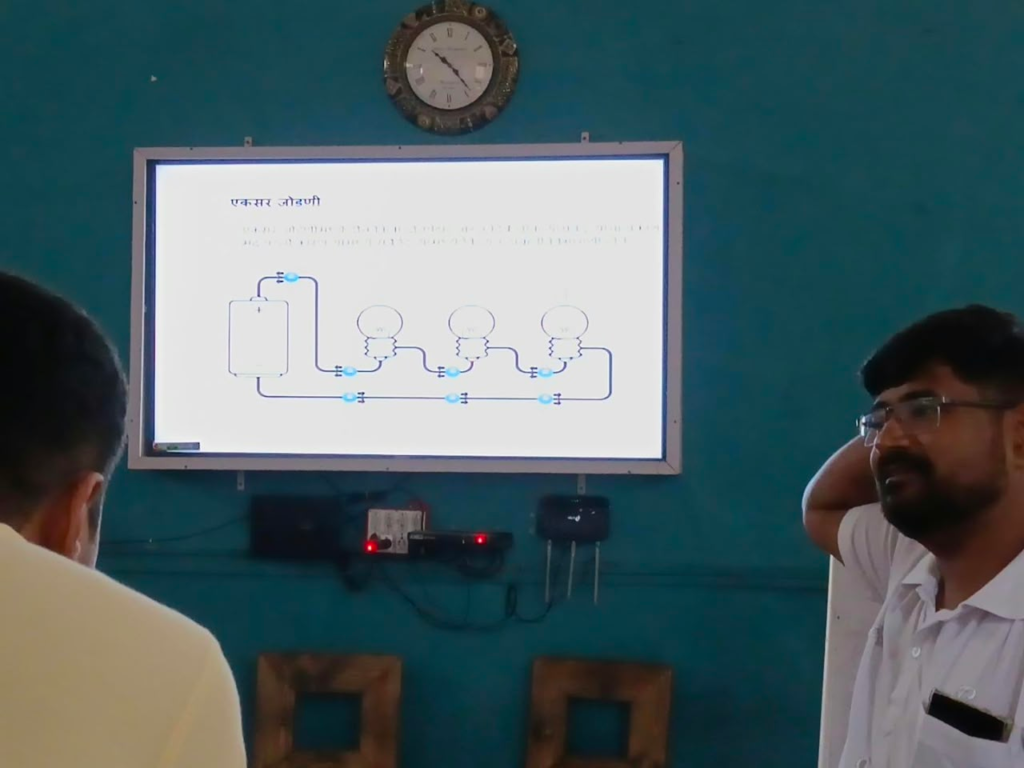
5. Series and parallel circuits
Series
Battery ── Lamp 1 ── Lamp 2 ── Battery
- Same current flows through each load.
- If one component opens, the circuit can stop working.
- Supply voltage is divided among the loads.
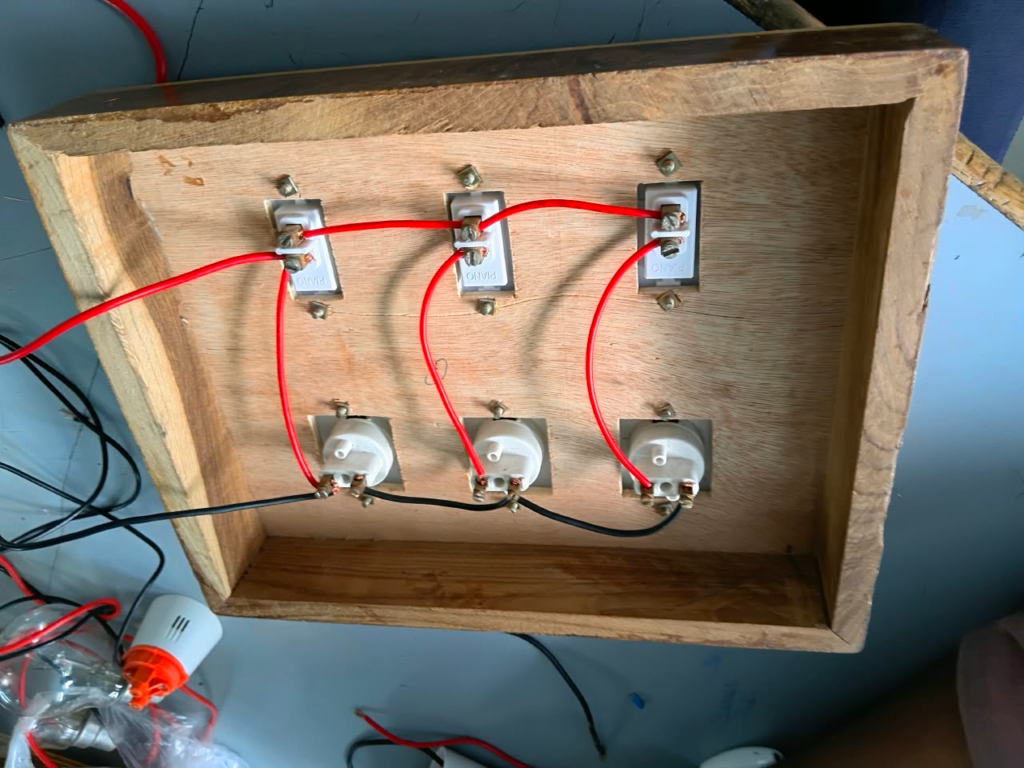
Parallel
             ┌── Lamp 1 ──┐
Battery ─────┤             ├──── Battery
             └── Lamp 2 ──┘
- Each branch gets the supply voltage.
- If one lamp fails open, the other branch can continue working.
- Household electrical circuits are generally arranged in parallel so individual loads can operate independently.
6. AC household circuit — basic concept
A simplified arrangement is:
       Distribution Board
              │
        ┌─────┴─────┐
        │           │
      MCB         MCB
        │           │
      Light       Socket
        │           │
        └─────┬─────┘
              │
           Neutral
An actual installation also includes protective earthing and appropriate protective devices. Mains electricity can cause fatal electric shock and fire, so don’t experiment with exposed 230 V wiring. For learning, start with a low-voltage DC circuit such as 5–12 V.
If you’re learning electrical work from the beginning, a useful order is: voltage → current → resistance → Ohm’s law → AC/DC → series/parallel circuits → switches → fuses/MCBs → earthing → multimeter basics → household wiring concepts.