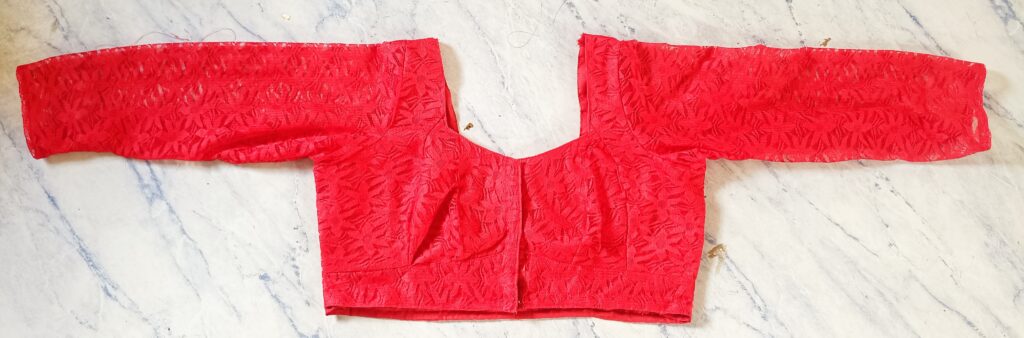
19 June 2026Today started with breakfast, and after that I went to the Asmita Department for my practical session. I began the day by giving the final finishing touches to my completed blouse. I carefully trimmed the extra threads, checked all the seams, and made sure the blouse had a neat and clean finish. Tai explained that finishing is one of the most important steps in garment making because it improves the overall appearance, comfort, and durability of the garment. She checked everyone’s work individually and guided us on how to correct small mistakes to achieve a professional result. Through this, I learned that even a perfectly stitched blouse requires proper finishing to look complete.After that, Tai introduced us to the Princess Katori Blouse. She brought a sample blouse made with net fabric and explained that its lining (astar) was made of cotton fabric. She taught us why net fabric always requires a suitable lining for comfort, strength, and a better finish. The sample blouse was originally stitched as a Katori blouse, where the cup area had a pointed shape. Tai explained that this pointed effect is common in traditional Katori blouses but is not always preferred in modern designs. She then demonstrated how to convert the same Katori blouse into a Princess Katori Blouse by changing the stitching lines and reshaping the cup. This removed the pointed look and created a smoother, softer, and more natural shape, giving the blouse a modern appearance and a better fit.Tai also explained the advantages of the Princess Katori style. She told us that it provides a more comfortable fit, improves the shape of the garment, and suits different body types. She demonstrated how to make changes in the pattern according to a person’s body measurements instead of using the same size for everyone. We learned how to increase or decrease the measurements while maintaining the correct proportions so that the blouse fits perfectly. She also discussed common fitting problems and explained how small pattern adjustments can solve them before stitching begins.After lunch, the session continued with learning how to take accurate body measurements. Tai demonstrated the correct method of measuring the bust, waist, hip, shoulder, neck, armhole, sleeve length, blouse length, front length, back length, and apex point. She explained where the measuring tape should be placed, how to keep it straight without pulling it too tight, and why accurate measurements are the foundation of a perfectly fitted blouse. We also practiced taking measurements under her guidance, which helped us understand the process better and increased our confidence.Before the class ended, Tai revised all the important concepts and answered our doubts regarding Princess Katori blouses, pattern adjustments, fabric selection, and measurements. She shared many practical tips from her tailoring experience and explained how careful measuring, correct pattern drafting, and neat stitching together create a professional-quality blouse. Today’s class was very informative because I learned how to transform a traditional pointed Katori blouse into a modern Princess Katori blouse, understood the importance of using net fabric with a cotton lining, and gained valuable knowledge about body measurements and size adjustments. It was one of the most useful practical sessions, and I learned many new techniques that will help me in future blouse-making projects.