Introduction
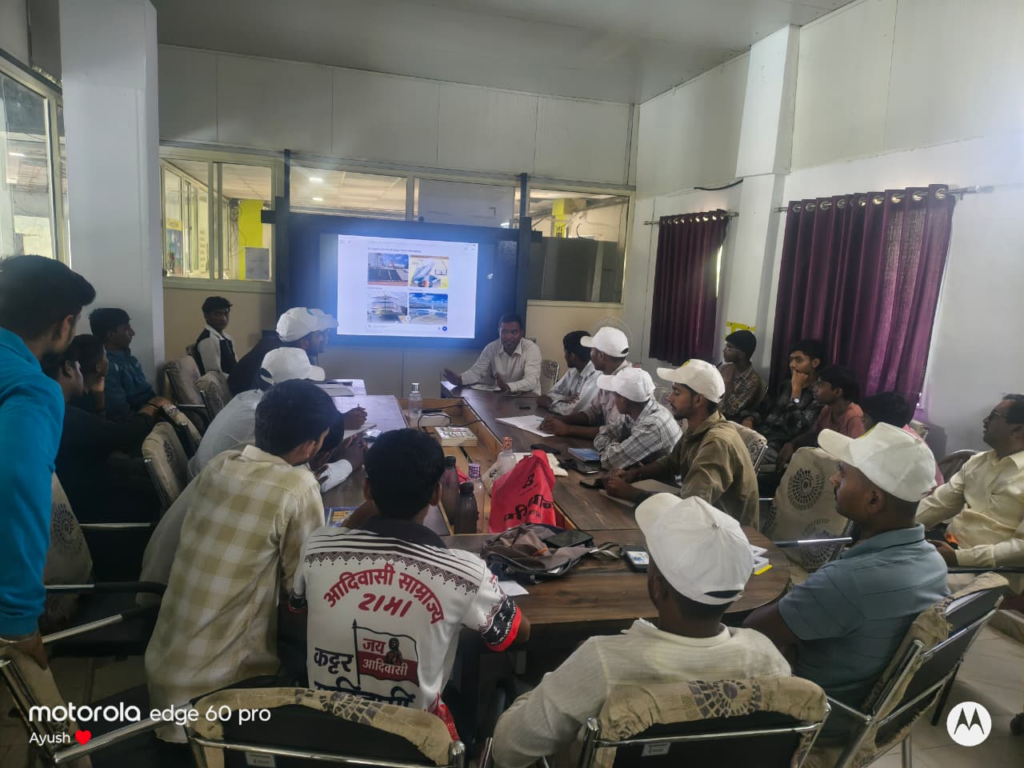
Today, I learned about conductors, semiconductors, and insulators, the manufacturing of solar cells and modules, and different solar energy applications. I also studied N-type and P-type semiconductors, band gaps, solar cell technologies, I-V curves, power generation, and electricity bill calculations. This session helped me understand the basic principles of solar energy and modern photovoltaic systems.
1. Conductors, Semiconductors, and Insulators
Conductors are materials that allow electric current to flow easily. Copper and aluminium are common examples. Semiconductors have electrical conductivity between conductors and insulators. Silicon is the most widely used semiconductor in solar cells. Insulators do not allow electric current to flow easily. Rubber, glass, and plastic are common examples used in electrical insulation.
2. Manufacturing of Solar Cells and Modules
I learned how solar cells and modules are manufactured. Silicon is processed and purified to produce suitable semiconductor material. The silicon is formed into wafers, which are treated to create a semiconductor junction. Electrical contacts and protective layers are added to improve the cell’s performance. Finally, solar cells are interconnected, laminated, and assembled into a solar module with protective glass and a frame. These modules convert sunlight into electrical energy.
3. Difference Between N-Type and P-Type Semiconductors
N-type and P-type semiconductors are important parts of solar cell technology.
- N-Type Semiconductor: It contains additional electrons as the majority charge carriers.
- P-Type Semiconductor: It contains holes as the majority charge carriers.
When N-type and P-type materials are joined, they form a PN junction. This junction helps separate charges generated by sunlight and produces electrical current in a solar cell.
4. Band Gap
The band gap is the energy difference between the valence band and the conduction band of a material. It determines how much energy is needed for electrons to move and participate in electrical conduction. Silicon has a band gap of approximately 1.12 electron volts (eV), making it suitable for photovoltaic applications.
5. Solar Thermal and Photovoltaic Applications
I studied two major applications of solar energy.
Solar thermal applications use sunlight to produce heat. Examples include solar dryers, solar water heaters, and solar cookers. Solar dryers are used to dry agricultural products, while solar water heaters provide hot water using solar energy.
Photovoltaic (PV) applications convert sunlight directly into electricity. Solar PV systems can power homes, offices, agricultural pumps, and other electrical equipment.
6. Types of Solar Cells and Advanced Technologies
I learned about different solar cell technologies, including monocrystalline silicon, polycrystalline silicon, thin-film, amorphous silicon, PERC, bifacial, TOPCon, and HJT technologies.
Bifacial solar panels can generate electricity from sunlight reaching both sides of the panel. TOPCon (Tunnel Oxide Passivated Contact) technology reduces electrical losses and improves efficiency. HJT (Heterojunction Technology) combines crystalline silicon with thin amorphous silicon layers to achieve high performance.
7. I-V Curve and Power
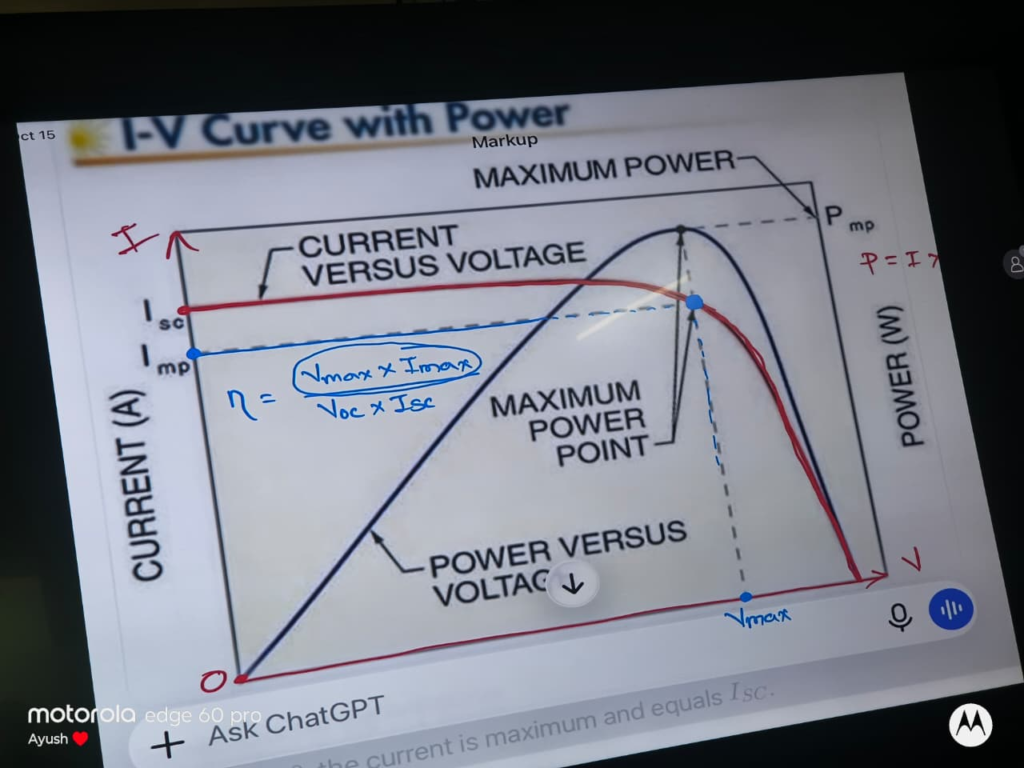
The I-V curve represents the relationship between current (I) and voltage (V) produced by a solar module. Important points include short-circuit current (Isc), open-circuit voltage (Voc), and maximum power point (MPP).
Electrical power is calculated using:
Power (P) = Voltage (V) × Current (I)
The maximum power point helps determine the operating condition at which a solar panel produces its highest power.
8. Electricity Bill Calculation
I also learned the basics of electricity bill calculation. Electrical energy consumption is measured in kilowatt-hours (kWh), commonly called units.
Units consumed = Power (kW) × Operating time (hours)
For example, a 1 kW appliance operating for 5 hours consumes 5 units of electricity. The electricity cost depends on the applicable tariff and additional charges.
Conclusion
Today’s learning session improved my understanding of semiconductor materials, solar cell manufacturing, solar thermal systems, and photovoltaic applications. I also gained knowledge of advanced solar technologies, I-V curves, power calculations, and electricity billing. These topics are important for understanding solar system design, installation, performance, and maintenance.