
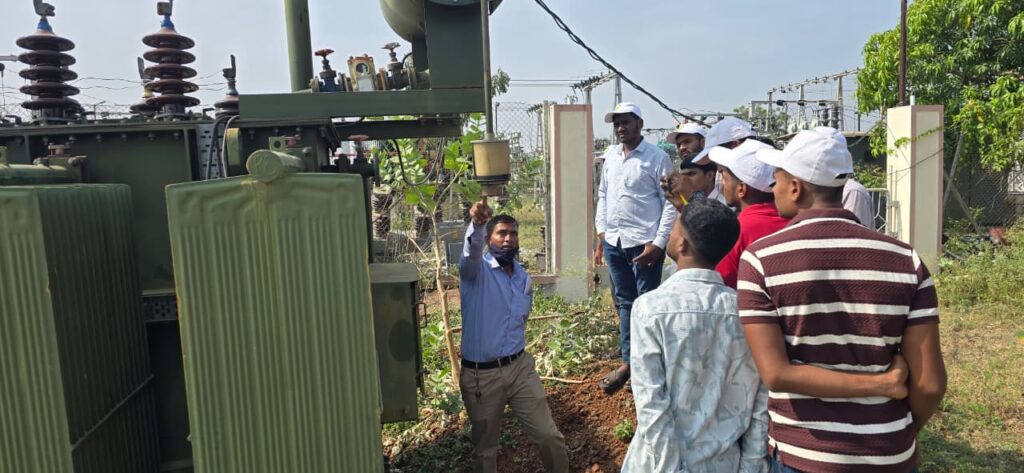
- What is an Electrical Substation?
An electrical substation is a place where electrical power is received, voltage is increased or decreased using transformers, and electricity is distributed to different areas.
In Maharashtra, electricity distribution is handled by Maharashtra State Electricity Distribution Company Limited (MSEDCL) (Mahavitaran), while transmission and other grid functions involve other electricity utilities. - Main Objectives of the Visit
- To understand the working process of an electrical substation.
- To learn how electricity is received and distributed.
- To identify transformers, circuit breakers, isolators and other equipment.
- To understand electrical safety and protection systems.
- To learn how electricity reaches homes, schools and industries.
- Main Equipment and Its Functions
- Power Transformer
It increases or decreases voltage according to the requirement of the electrical network. - Circuit Breaker
It automatically interrupts the electrical supply during faults such as short circuits. - Isolator
It separates electrical equipment from the supply for maintenance after the circuit is safely disconnected. - Busbar
It connects incoming and outgoing electrical circuits within the substation. - Protection Relay and Control Panel
It monitors electrical conditions and helps detect faults and operate circuit breakers. - Lightning Arrester
It protects electrical equipment against dangerous voltage surges caused by lightning and switching.
These are common substation components; the exact equipment depends on the substation design.
Bharat Skills
+2
- Working Process of an MSEB Substation
- Incoming Supply
Electricity received from the transmission network - Switching and Protection
Circuit breakers, isolators and protective devices - Busbar
Connects and distributes power between circuits - Transformer
Voltage is changed as required - Outgoing Feeders
Supply sent towards distribution networks - Consumers
Homes, schools, farms and industries
Note: The actual order and arrangement vary by substation type. Some substations only switch or transmit power, while distribution substations step down voltage for local supply.
- Electrical Safety Observations
- Follow all instructions given by the substation engineer.
- Never touch transformers, wires, panels or other electrical equipment.
- Maintain the required safety distance from high-voltage equipment.
- Do not enter restricted areas or operate any switches.
- Observe earthing, warning signs and protective equipment from a safe location.