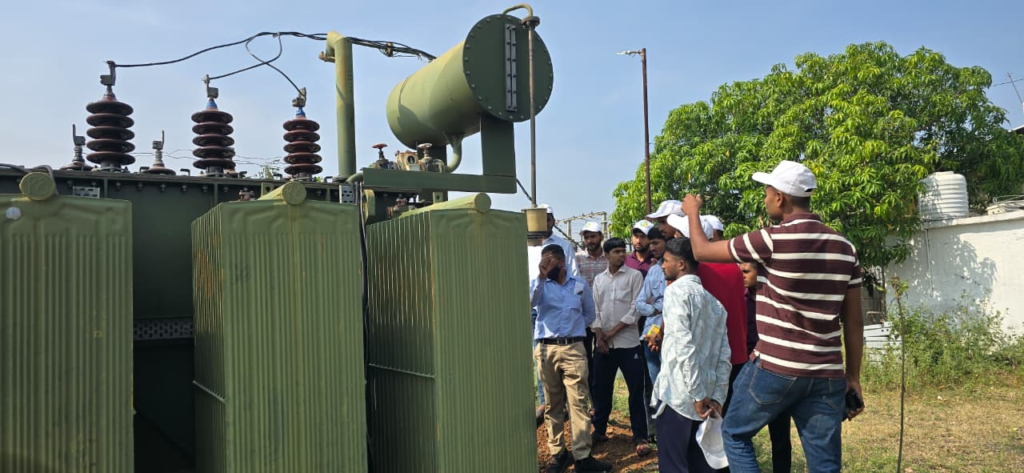
Today, I visited a 33 kV to 11 kV electrical substation to understand the working principles of transformers and the process of electrical power distribution. During this field visit, we learned about transformer parts, windings, earthing, capacitor banks, the electrical grid, and the control centre. This visit helped us connect our theoretical knowledge with practical applications in the electrical field.
Step 1: Understanding the Electrical Substation
A 33 kV to 11 kV substation receives electrical power at 33 kV and reduces the voltage to 11 kV using a step-down transformer. The 11 kV supply is then distributed to different areas through outgoing feeders. Further distribution transformers reduce the voltage to a suitable level for domestic, commercial, and other consumers.
Step 2: Understanding the Transformer Working Principle
We learned that a transformer works on the principle of mutual electromagnetic induction. When alternating current flows through the primary winding, it produces a changing magnetic field in the core. This magnetic field induces voltage in the secondary winding.
In a step-down transformer, the primary winding has more turns than the secondary winding. Therefore, the voltage decreases from 33 kV to 11 kV, while the current capacity increases according to the power requirements and transformer rating.
Step 3: Studying Transformer Parts
We observed and learned about the major parts of a transformer:
- Core: Provides a path for magnetic flux.
- Primary winding: Receives electrical power at the input voltage.
- Secondary winding: Delivers electrical power at the reduced voltage.
- Transformer oil: Provides insulation and helps remove heat in oil-filled transformers.
- Radiators: Help dissipate heat and maintain the operating temperature.
- Bushings: Provide insulated connections for conductors entering or leaving the transformer.
- Conservator and breather: Help manage oil expansion and reduce moisture entering the transformer in designs that use these components.
Step 4: Learning About Transformer Windings
We studied the primary and secondary windings and understood their roles in voltage transformation. The number of turns in each winding determines the voltage ratio. Proper insulation between the windings and the core is essential for safe and reliable operation.
Step 5: Understanding Earthing
Earthing is an important safety measure in a substation. Equipment earthing provides a safe path for fault current, helping protective devices operate and reducing the risk of electric shock. Neutral earthing is used where required by the electrical system design. We understood why proper earthing is necessary for the protection of people and equipment.
Step 6: Studying the Capacitor Bank
We learned about capacitor banks, which are used to improve the power factor by supplying reactive power. They help reduce reactive current and can improve voltage regulation and reduce losses when correctly designed and operated.
Step 7: Understanding the Electrical Grid
The electrical grid connects generating stations, transmission lines, substations, distribution networks, and consumers. The substation acts as an important link between the 33 kV supply network and the 11 kV distribution system.
Step 8: Visiting the Control Centre
At the control centre, we learned how operators monitor electrical parameters such as voltage, current, and equipment status. Protection relays, circuit breakers, and monitoring systems help operators identify faults and isolate affected sections of the network.
Conclusion
This field visit was a valuable learning experience. We gained practical knowledge about transformer working principles, winding arrangements, major transformer parts, earthing, capacitor banks, the electrical grid, and the control centre. It helped us understand how electrical power is received, its voltage is reduced, and electricity is distributed safely and efficiently. Overall, the visit improved our technical knowledge and gave us a better understanding of real-world electrical power systems.