
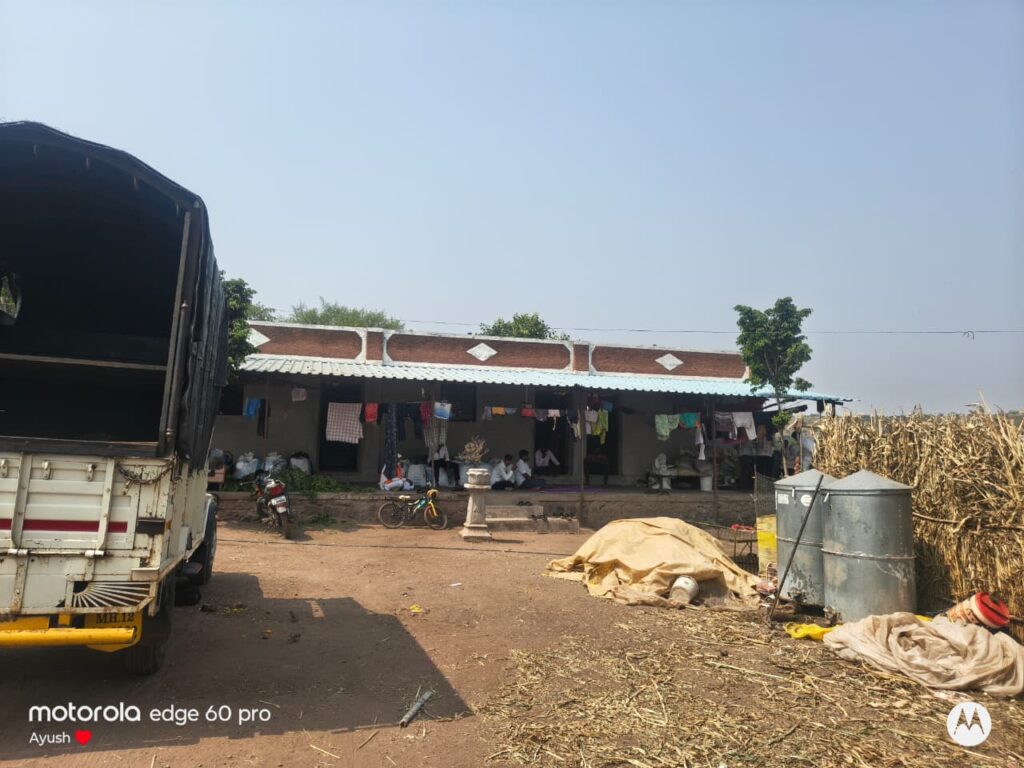
Solar Installation Survey and Load Calculation – Village Survey Report
1. Introduction
A village survey for solar installation is conducted to assess the electricity requirements of households, identify suitable locations for solar panels, and estimate the capacity of a solar power system. The survey helps determine the number of solar panels, battery capacity, inverter rating, and overall system requirements.
2. Objectives of the Survey
- To collect information about electricity consumption in the village.
- To identify households suitable for solar installation.
- To calculate the daily electrical load of each household.
- To estimate the required solar panel capacity.
- To assess rooftop space, sunlight availability, and shading conditions.
- To promote renewable energy and reduce dependence on conventional electricity.
3. Village Survey Data
The following is a sample survey table. Replace the figures with actual field survey data.
| Sr. No. | Survey parameter | Sample data |
|---|---|---|
| 1 | Name of village | __________ |
| 2 | Taluka and district | __________ |
| 3 | Total households surveyed | 50 |
| 4 | Households with electricity | 45 |
| 5 | Households without electricity | 5 |
| 6 | Average daily electricity supply | 18–24 hours |
| 7 | Households suitable for rooftop solar | 35 |
| 8 | Average monthly electricity bill | ₹500–₹1,000 |
| 9 | Available installation area | Rooftops / open land |
| 10 | Main energy requirement | Lighting, fans, TV, mobile charging |
4. Household Electrical Load Survey
A typical household’s electrical appliances and their estimated energy consumption are shown below.
| Appliance | Quantity | Power per unit | Daily use | Energy per day |
|---|---|---|---|---|
| LED bulbs | 4 | 9 W | 5 hours | 180 Wh |
| Ceiling fans | 2 | 60 W | 8 hours | 960 Wh |
| Television | 1 | 80 W | 4 hours | 320 Wh |
| Mobile chargers | 2 | 10 W | 3 hours | 60 Wh |
| Refrigerator | 1 | 150 W | 8 equivalent hours | 1,200 Wh |
| Total | 2,720 Wh/day |
Note: Refrigerator consumption is an illustrative estimate based on equivalent running hours. Actual energy use should be measured or obtained from the appliance’s energy label.
5. Load Calculation
A. Connected load
Connected load is calculated by multiplying the quantity of each appliance by its rated power.
For the sample household:
- LED bulbs:
- Fans:
- Television:
- Mobile chargers:
- Refrigerator:
B. Daily energy consumption
Where:
- = daily energy consumption in kWh
- = appliance power in watts
- = daily usage in hours
- = number of appliances
For the sample household:
Therefore, the estimated daily electricity requirement is 2.72 units per day.
6. Solar System Capacity Calculation
Assume the household requires 2.72 kWh/day, receives 5 equivalent peak-sun hours per day, and the overall solar-system performance ratio is 0.75.
The calculated minimum is approximately 0.73 kW. A 1 kWp solar system is a reasonable preliminary option for further assessment, subject to seasonal sunlight, shading, roof orientation, actual energy use, and backup requirements.
7. Battery and Inverter Sizing
For a preliminary off-grid system, assume one day of battery autonomy and a 48 V battery bank.
- Daily energy requirement: 2.72 kWh
- Assumed inverter efficiency: 90%
- Assumed battery depth of discharge: 80%
Required nominal battery energy:
At 48 V:
A nominal battery capacity of approximately 48 V, 100 Ah is an illustrative starting point, with the final choice depending on battery chemistry, usable capacity, temperature, and required backup time.
An inverter rated around 1 kVA may be suitable for this example only if simultaneous loads, refrigerator starting surge, and future expansion are verified.
For a grid-connected system without battery backup, battery sizing may not be necessary.
8. Site Survey for Solar Installation
The following parameters should be checked during the village visit:
- Roof type, condition, and available area.
- Direction and tilt of the roof.
- Shading from trees, buildings, and other obstructions.
- Solar irradiation and seasonal sunlight conditions.
- Existing electricity connection and meter details.
- Earthing, lightning protection, and cable routing.
- Safety and accessibility for installation and maintenance.
- Household electricity bills and actual daily consumption.
- Grid availability and required backup duration.
9. Estimated Survey Summary for 50 Households
For illustration, if 35 households are suitable for solar installation and each installs a 1 kWp system:
| Parameter | Estimated value |
|---|---|
| Suitable households | 35 |
| Proposed capacity per household | 1 kWp |
| Total proposed solar capacity | 35 kWp |
| Assumed peak-sun hours | 5 hours/day |
| Performance ratio | 0.75 |
| Estimated daily generation | 131.25 kWh/day |
| Estimated annual generation | 47,906 kWh/year |
These are preliminary estimates, not measured generation figures. Actual output will vary with local weather, shading, system losses, and seasonal conditions.
10. Conclusion
The village survey identifies household electricity requirements and evaluates the feasibility of installing solar power systems. Based on the illustrative household load calculation, a daily energy demand of 2.72 kWh corresponds to a preliminary solar capacity of approximately 1 kWp. A complete installation plan should be finalized after site inspection, load verification, and assessment of whether the system will be grid-connected or off-grid.
