
Basic Electrical Information
1. Earthing (अर्थिंग)
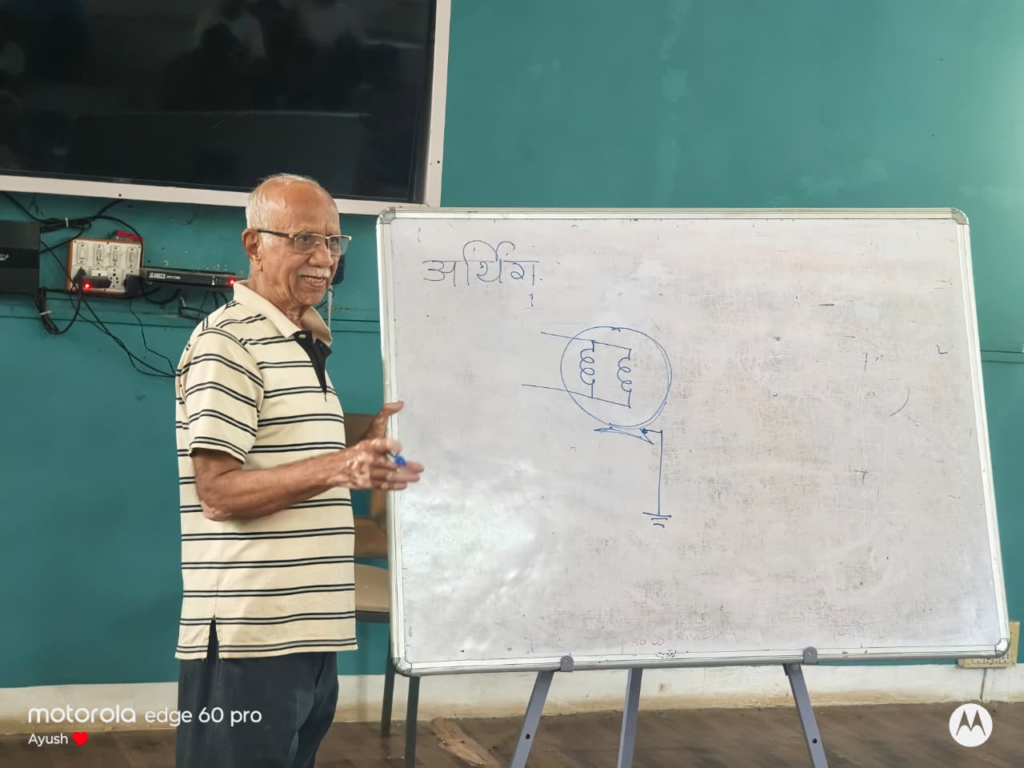


5
Earthing is a safety system that connects the metal body of electrical equipment to the ground. If a fault causes current to flow onto the metal body, earthing provides a path for the fault current to flow safely to earth and helps protective devices disconnect the supply.
Main purpose: Protect people from electric shock and reduce the risk of equipment damage.
Important points
- Earth wire is commonly identified by green or green-yellow insulation.
- Earthing is different from neutral; they have different functions.
- Earthing should be installed and tested according to electrical safety standards.
2. Ohm’s Law
Ohm’s Law explains the relationship between voltage, current, and resistance in an electrical circuit.
Ohm’s Law
V=I×R
Voltage = Current × Resistance
| Symbol | Meaning | Unit |
|---|---|---|
| V | Voltage | Volt (V) |
| I | Current | Ampere (A) |
| R | Resistance | Ohm (Ω) |
Example
A 12 V supply is connected to a 6 Ω resistor.
I=RV=612=2 A
The current is 2 amperes.
The interactive Ohm’s Law calculator below lets you change voltage and resistance and see how current changes.
Ohm’s Law calculator
InteractiveVoltage
12 VResistance
6 Ω
Calculated current
2.00 A
I=frac126Reset example
3. Difference between AC and DC
AC
Alternating Current
Current changes direction periodically.
Example: Household mains supply.
DC
Direct Current
Current flows in one direction.
Example: Battery and DC adapter.
| Feature | AC | DC |
|---|---|---|
| Full name | Alternating Current | Direct Current |
| Direction | Changes periodically | One direction |
| Common source | AC generator, mains | Battery, DC adapter |
| Example | 230 V household supply | 12 V battery |