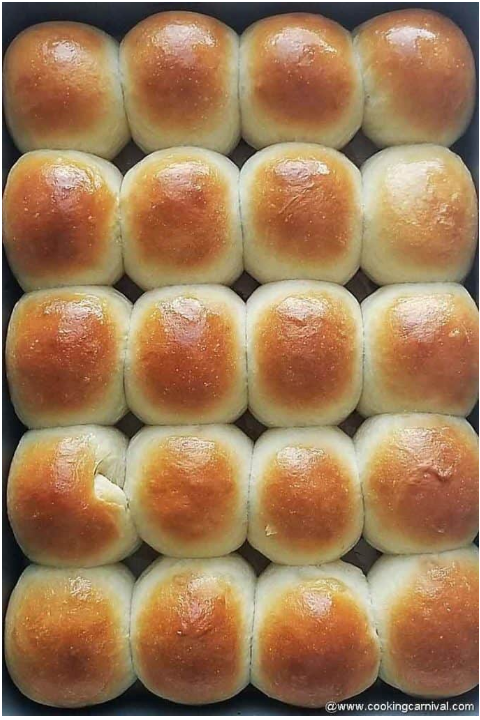
Paav
Objective
Materials Used
To learn how to make soft pav and understand the ingredient costing and production cost.
- Maida
- Yeast
- Salt
- Sugar
- Bread improver
- Lukewarm water
Process
- First, all the ingredients were measured properly.
- Maida was taken in a large mixing vessel.
- Yeast, sugar, salt and bread improver were added.
- All the dry ingredients were mixed well.
- Lukewarm water was added slowly to make a soft dough.
- The dough was kneaded properly until it became smooth.
- The dough was kept for first fermentation for 10–15 minutes.
- After fermentation, the dough was kneaded again.
- The dough was divided into equal parts of approximately 55 g each.
- Each part was shaped into pav and placed on a greased tray.
- The pav was kept for final fermentation for 1–1.5 hours.
- The oven was preheated to 180°C.
- The pav was baked in the oven until it was properly cooked.
- After baking, the pav was kept aside to cool.
Costing
| Sr. No. | Material | Quantity | Rate | Price |
|---|---|---|---|---|
| 1 | Maida | 7 kg | ₹50/kg | ₹350 |
| 2 | Yeast | 150 g | ₹180/kg | ₹27 |
| 3 | Salt | 150 g | ₹30/kg | ₹4.50 |
| 4 | Sugar | 250 g | ₹80/kg | ₹18 |
| 5 | Bread Improver | 14 g | ₹500/kg | ₹7 |
| 6 | Oven Charge | 3 units | ₹10/unit | ₹30 |
| Total | ₹436.50 | |||
| Labour Charge (35%) | ₹152.78 | |||
| Final Cost | ₹589.28 |
Result
We successfully prepared soft pav. We learned how to measure ingredients, prepare dough, knead, ferment, shape and bake pav. We also calculated the total cost of production.
Conclusion
Through this activity, I learned how to make soft pav step by step. I also learned how to calculate ingredient costs, labour charges and total production costs.