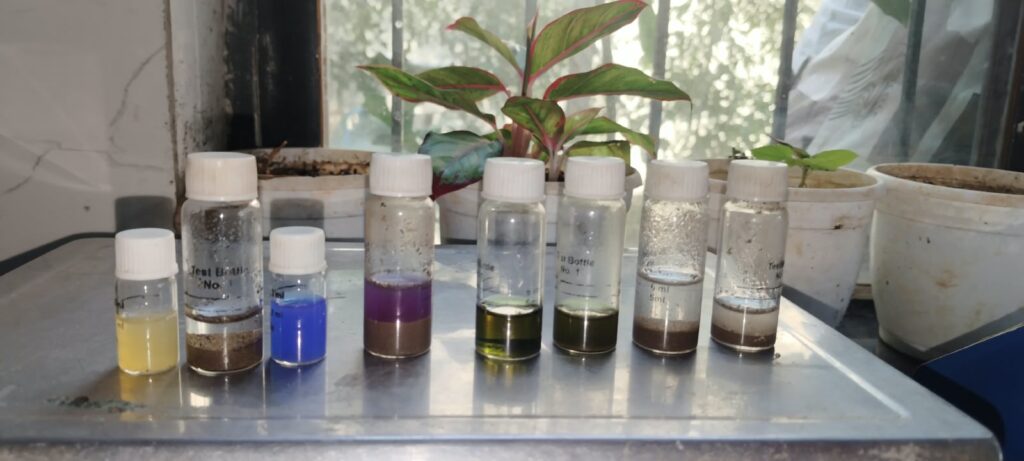
Sure. Soil testing is the process of analyzing soil to determine its physical and chemical properties, especially nutrient availability and suitability for crops or construction.
🌱 Agricultural soil testing
A typical soil test checks:
pH – whether soil is acidic or alkaline
Electrical conductivity (EC) – indicates soluble salts/salinity
Organic carbon – an indicator of soil organic matter
Nitrogen (N)
Phosphorus (P)
Potassium (K)
Sulphur (S)
Micronutrients such as zinc, iron, manganese, copper and boron
Sometimes texture, moisture, calcium, magnesium and soil bulk density
🧪 How to collect a soil sample
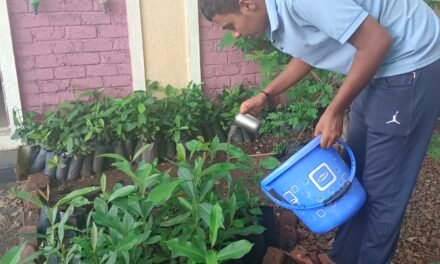
Take samples from several representative spots in the field.
Avoid unusual areas such as manure heaps, fertilizer piles, bunds, or recently fertilized spots.
For most cultivated fields, collect soil from about 0–15 cm depth.
Mix the samples thoroughly in a clean container.
Take a representative portion (commonly around 500 g–1 kg, depending on the laboratory).
Label it with the field/location, crop, depth and date.
Send it to a soil testing laboratory for analysis.
📋 What the report tells you
The laboratory results can be used to determine fertilizer and soil-amendment requirements. For example, a low potassium result may indicate a need for additional potassium fertilizer, while an unsuitable pH may require a soil amendment.
If you tell me whether you need soil testing for farming, gardening, construction, or a specific crop, I can give you the appropriate testing procedure, parameters, sample format, and interpretation.